Rural and Ready: Keeping Opportunity Close to Home Through AP and the SAT Suite
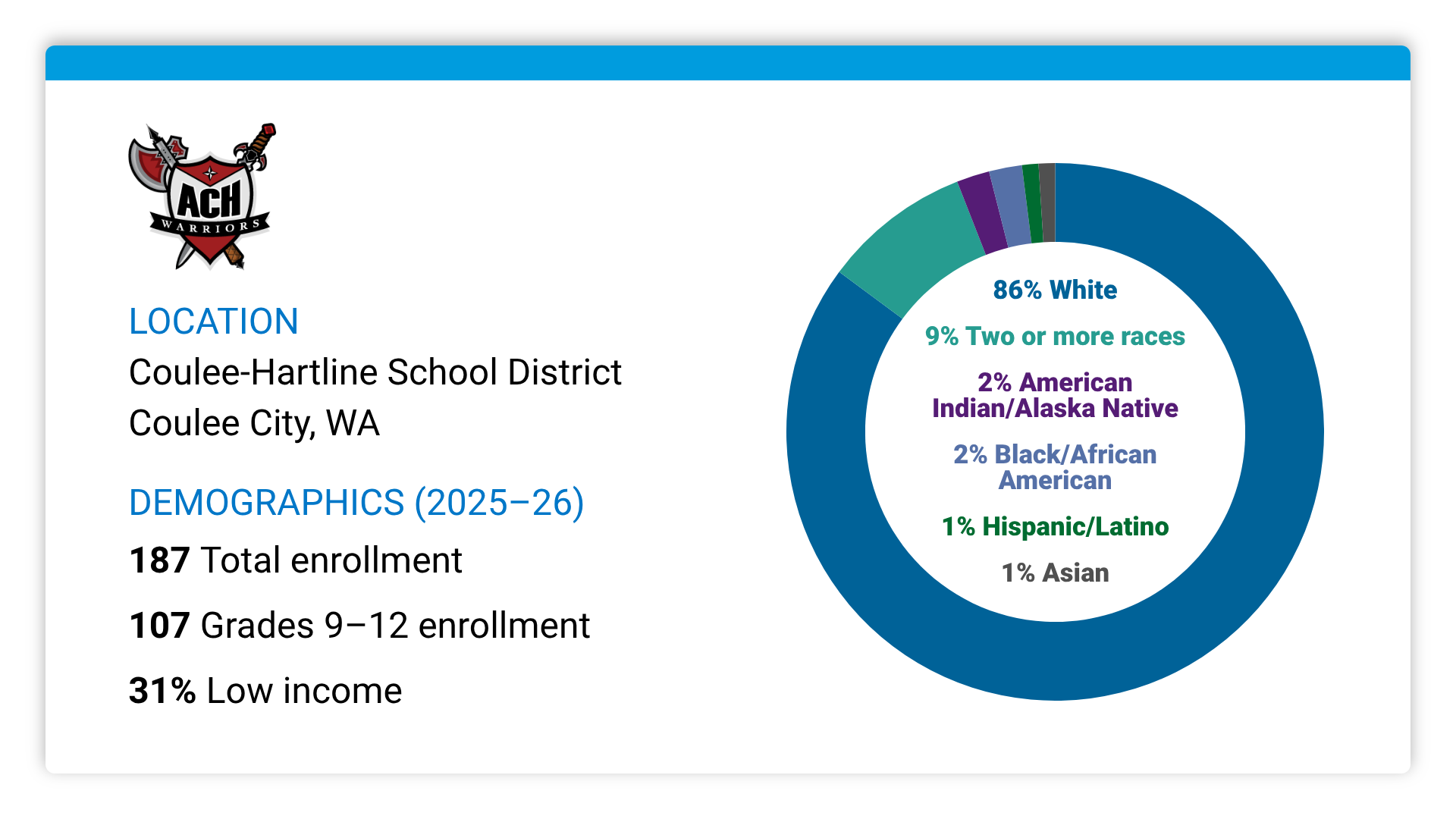
High school is where readiness becomes reality, shaping the competencies and habits that power success beyond graduation. It serves as the critical bridge where students build the skills and mindsets needed for their future college and/or career path. But when the nearest four-year college is 100 miles away—and the nearest community college is more than 50—college can seem distant both in miles and attainability. At Almira Coulee-Hartline (ACH) High School, the only high school in our rural Washington State district, we serve 107 students in grades 9–12. More than half of our seniors are first-generation college students. Our challenge has never been whether our students can get into college. It has been ensuring they are prepared to persist and thrive once they arrive.
That belief has shaped our approach. By leveraging the SAT Suite of Assessments and strategically expanding Advanced Placement® courses, we’ve built a cohesive readiness system that helps us measure where students are, identify potential, prepare them with advanced coursework, and validate growth with nationally recognized expectations.
Identifying the Opportunity
In our 2024–25 graduating class of 21 students, 9 enrolled in a four-year university, 2 attended community college, 2 pursued the trades, 1 joined the military, and others entered the workforce. Eleven of those 21 seniors come from families navigating college admissions, financial aid, and scholarship systems for the first time.
Our rural context adds complexity. The nearest community college is more than 50 miles away. Washington State’s Running Start, a free program allowing 11th and 12th graders the chance to complete high school and two years of college on a community college campus, offers valuable postsecondary preparation. At the same time, participation requires students to leave our high school environment for much of the day and can reduce district funding tied to enrollment. More importantly, we found that earning college credit quickly is not the same as being fully prepared for college-level rigor.
So, we began to ask ourselves a pivotal question: How do we build readiness—not just access?
The answer was twofold. First, we leveraged the SAT Suite, bringing testing on campus to reduce logistical barriers. Second, we expanded AP to intentionally establish a strong, school-based foundation for advanced coursework since we’ve found that student success often relies on the supportive environment of their home high school. Our teachers know our students personally. They understand their learning styles, family dynamics, and social-emotional needs. That connection matters.
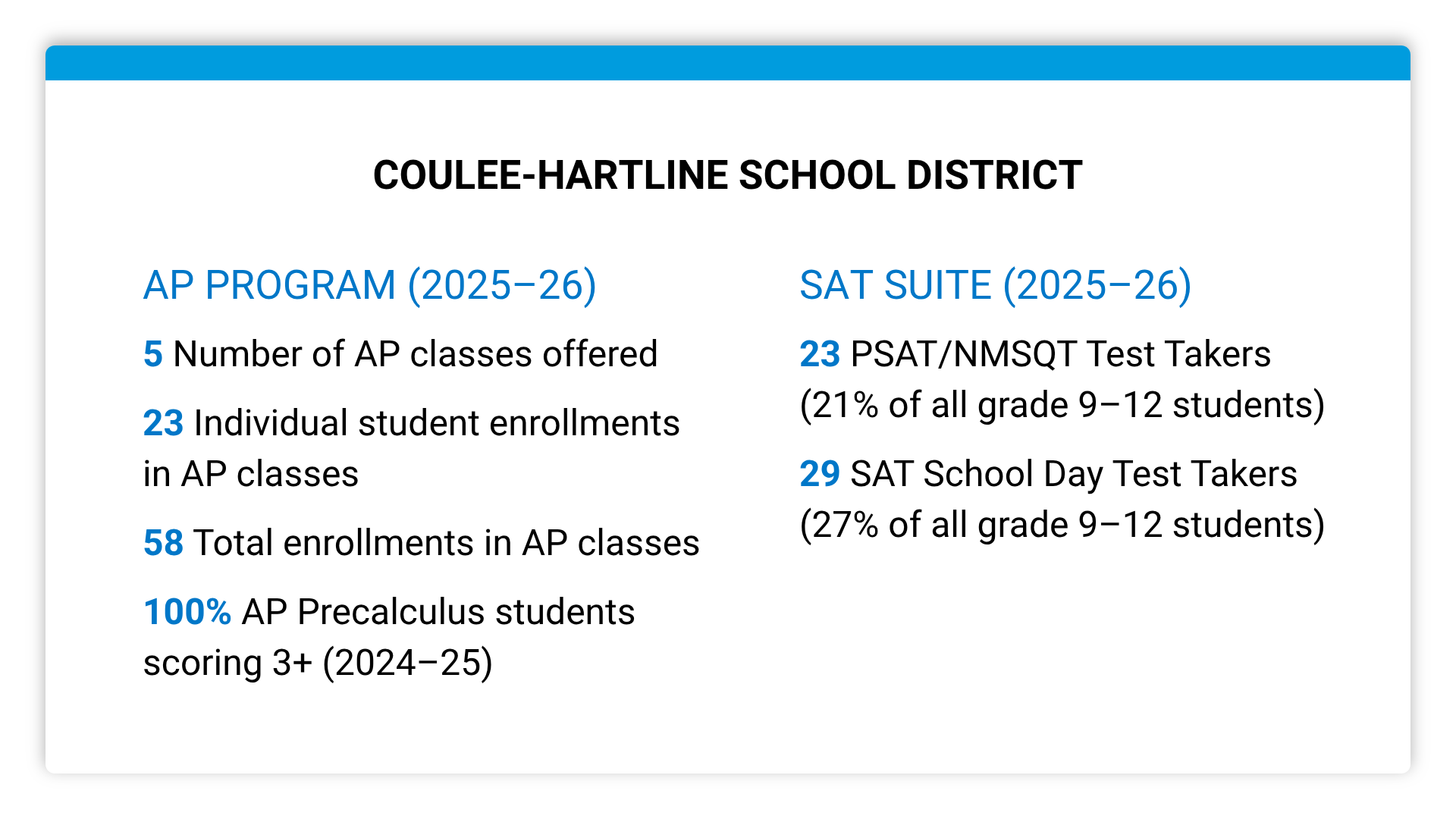
All juniors take the PSAT/NMSQT and, in the spring, we offer SAT School Day to juniors, providing valuable practice experience ahead of the senior fall SAT administration. Testing together in a familiar setting for SAT School Day has built camaraderie and reduced anxiety. Previously, some students traveled up to two hours to take the SAT on a weekend. Offering the SAT during the school day eliminated that barrier and strengthened our college-going culture. Students now approach SAT School Day with pride and confidence, rather than apprehension.
“AP and SAT participation are strongly connected to postsecondary outcomes in our district, reinforcing our core belief: Success is not about earning college credit as quickly as possible—it’s about building the confidence, skills, and academic readiness to thrive.”
Jennifer Goetz
AP Teacher and School Counselor
We also use SAT Suite insights and the AP Potential™ tool to identify students who are likely to succeed in AP coursework—including those who may not yet see themselves as “AP students.” In a small rural district, access isn’t just about offering courses; it’s also about noticing potential early and inviting more students into rigorous learning with the right support.
Turning Opportunity into Action
This school year, we began a pilot to transition English 10 to AP Seminar after recognizing gaps in writing, research, and argumentation skills. We knew that if students were going to succeed in coursework generally, including AP coursework, they needed a stronger academic foundation earlier in high school.
English 10: AP Seminar strengthens critical thinking, source analysis, and academic writing. In today’s world—where AI tools are increasingly used—students must know how to discern credible sources, construct arguments ethically, and think independently.
In mathematics, we added AP Precalculus as a clearly defined bridge between Algebra II and AP Calculus. This intentional sequencing has transformed our math pathway. Students are not skipping ahead prematurely. They are building depth of understanding and are required to explain their reasoning both verbally and in writing. As a result, students are pushed beyond simply finding the right answer.
Across disciplines, our AP teachers emphasize growth over perfection. Students often enter these courses anxious and unsure. Over time, that anxiety becomes a catalyst for confidence. Discussions deepen. Writing strengthens. Students begin to see themselves differently—not just as high school students, but as capable scholars.
We frame AP not as a race to accumulate credit, but as preparation for persistence. Because AP Exams provide a national, standardized measure of proficiency, students earn college credit only when they have truly demonstrated readiness. Even those who do not earn a qualifying score of 3 or more leave with skills that give them a measurable advantage in postsecondary settings.
“Don’t underestimate the impact of providing AP opportunities in a rural or underserved setting. These courses offer students access to college-level rigor and credit without needing to leave their community. With planning, a small school can offer big opportunities.”
Kelley Boyd
Superintendent, Coulee-Hartline School District, and Principal, ACH High School
Evaluating the Outcomes
The results affirm our approach.
Between 2019 and 2025, the number of AP Exams taken more than tripled, increasing from 23 to 72 and the number of scores earning 3 or higher rose 42%. In fact, of the 72 exams taken in the 2024–25 school year, nearly 70% earned a qualifying score for college credit with one student earning a qualifying score on all four exams taken.
In AP Precalculus, we achieved a 100% pass rate—evidence that thoughtful sequencing and strong instruction make rigorous coursework accessible, even in a small rural system.
Overall, participation in AP has grown steadily, and each additional course has expanded access to college-level learning. SAT Suite participation has grown alongside it. For the class of 2025, 43% took at least one AP course, 48% took the SAT, and 100% of them took the PSAT/NMSQT.
More importantly, we see the impact beyond the data. Former students return from college telling us they felt prepared—confident in tackling complex writing assignments, capable in higher-level math, and ready for the pace of university coursework. College feels like the “next step,” not a giant leap.
We also see increased scholarship opportunities and stronger four-year college enrollment among students who participate in AP and take the SAT—creating synergy for our students and families.
These results require systemic support to ensure long-term quality and foster continuous professional growth. So, we are requiring AP teachers to attend AP Summer Institutes at least once every four years.
In rural districts like ours, geography should not determine opportunity. With intentional planning, a commitment to access, and belief in our students’ potential, even our community of just 107 high school students can benefit from nationally recognized rigor and measurable preparation for life beyond graduation.
“Students experience an increase in confidence when they see themselves as capable of success. I believe all students have the long-term benefit of developing skills in analysis, synthesis, logical reasoning, and justification. These skills apply to just about any area of life.”
Nicole Carstensen
AP Math Teacher
Practical Pointers
Define your Purpose: Frame AP as a tool for preparing students to succeed in college, not just earn credit early.
Success Starts in the Community: Students excel when they can lean on established connections with their high school teachers, peers, and support systems.
Use Data to Help Broaden Access: Use SAT Suite insights, including AP Potential, to invite more students into advanced learning.
Build Teacher Capacity: Invest in AP training, such as AP Summer Institutes, and collaborative planning, so teachers feel supported and confident.