Using Pre-AP to Expand Access and Improve AP Outcomes
Houston Independent School District (HISD) improved AP outcomes by expanding access to Pre-AP. Over the past two years, we significantly increased Pre-AP enrollment and saw corresponding gains in students taking AP exams and earning qualifying scores.
Identifying the Opportunity
We identified a disconnect between student potential and access to advanced coursework. While assessment data showed many students were ready for more rigorous learning, enrollment in Pre-AP and AP courses often depended on self-selection or localized advocacy.
Without clear, systemwide criteria, access varied by campus. Students who didn’t understand the importance of advanced courses, or did not have someone encouraging them, were less likely to enroll even when they were academically ready.
We needed a more consistent and accessible system to identify readiness and ensure students enrolled in courses that matched their potential.
Turning Opportunity into Action
We used Pre-AP as a key lever to expand access to advanced coursework and strengthen student preparation for AP.
Step 1: Implement an advanced course opt-out policy.
We shifted from an opt-in model to an opt-out model so students who meet specific academic benchmarks are automatically placed into Pre-AP and AP courses. We used multiple measures of readiness, including the State of Texas Assessment of Academic Readiness (STAAR), PSAT assessments, and SAT performance, to identify students who are ready—or close to ready—for rigorous coursework. This policy shift helped ensure students could access advanced coursework earlier and build the skills needed for success in AP.
Step 2: Add Pre-AP and AP sections across core subjects.
To support increased enrollment, we expanded the number of Pre-AP and AP course sections offered across our campuses for core subject areas. Increasing course availability allowed more students to participate in advanced coursework regardless of where they attend school.
Step 3: Build Pre-AP into master schedules.
We redesigned master schedules so that Pre-AP courses are built into the school day for students rather than treated as optional add-ons. Embedding Pre-AP into schedules helped make advanced coursework the default and created a more consistent pipeline from Pre-AP to AP across the district.
Step 4: Invest in teacher preparation.
We invested in professional learning to ensure strong instruction across the Pre-AP to AP pipeline. Teachers attend Pre-AP and AP Summer Institutes to build familiarity with course frameworks and instructional strategies before teaching a new course.
Step 5: Provide ongoing instructional support.
Pre-AP and AP teachers participate in professional learning communities (PLC) throughout the school year. During PLC meetings, teachers analyze student work, share instructional practices, and use tools such as Pre-AP and AP Classroom to monitor student progress and adjust instruction.
"Focusing on what a thesis statement looks like and using evidence has translated very well for us as students move into AP."
Pre-AP teacher
Evaluating the Outcomes
In two years, we’ve seen:
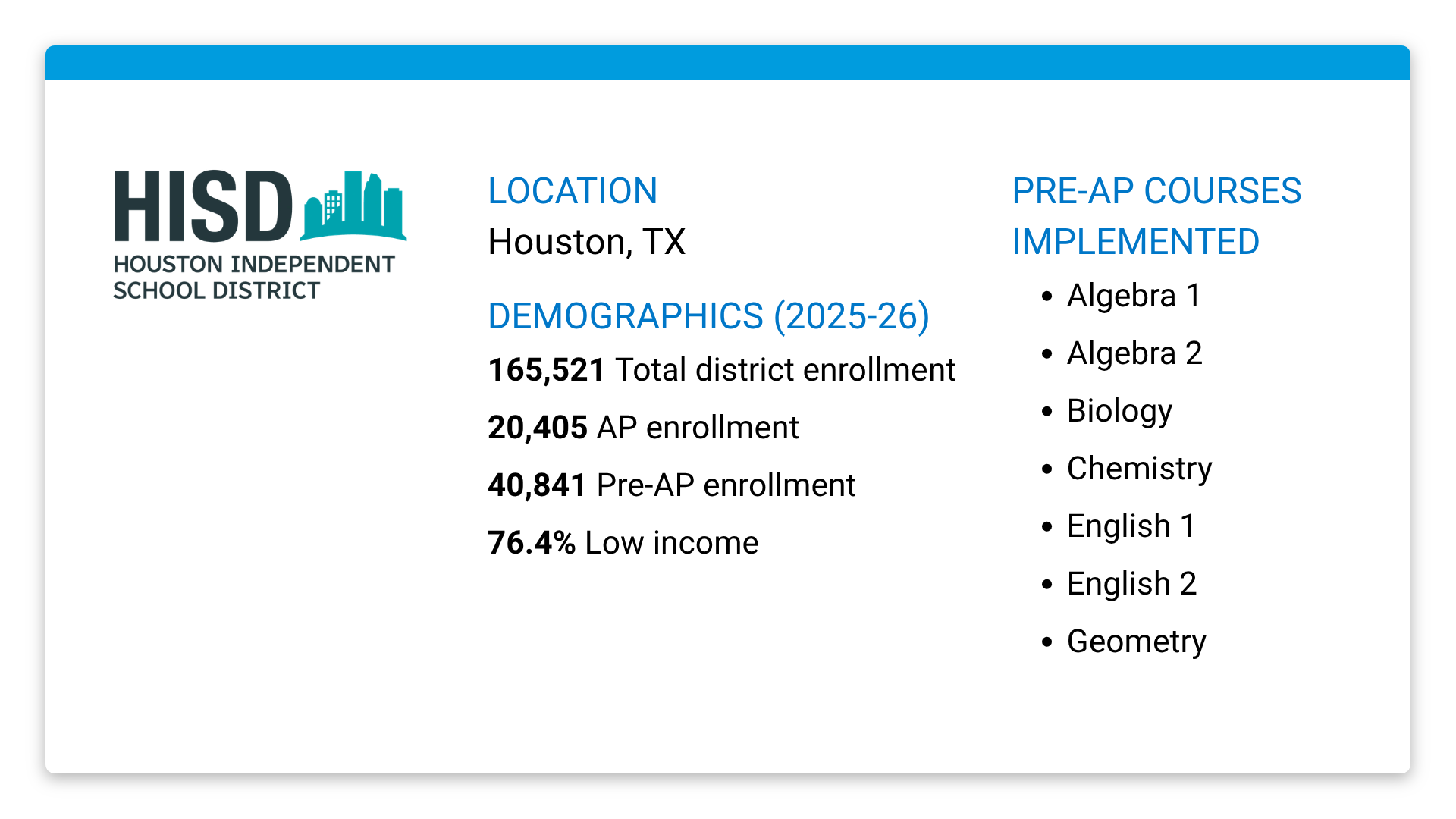
- Rapid growth in Pre-AP enrollment: Pre-AP enrollment grew 128%, from 17,940 to 40,841.
- Expanded participation in AP Exams: Students taking AP Exams increased by 11%, and the total number of AP Exams administered increased by 23%.
- Increased AP Exam success: AP Exam passing rates rose from 44% to 52% (+18%) with an increase of over 5,000 qualifying scores of 3 or higher.
Providing earlier access to rigorous coursework through Pre-AP prepared our students to succeed in AP. As more Pre-AP students progress through high school, we expect continued growth in AP participation and performance.
"Students come full circle because they’re revisiting some things [in AP English Language and Composition] that they did in 10th-grade Pre-AP English."
AP teacher
Practical Pointers
Use Pre-AP to Build a Pipeline into AP: Expand access to Pre-AP courses and enroll students earlier based on readiness. Use Pre-AP to develop the skills students need to succeed in AP coursework.
Make Placement into Pre-AP and AP the Default: Use multiple measures of student data to identify readiness and automatically place students into Pre-AP and AP courses. Shift from opt-in to opt-out enrollment to ensure more students have access.
Align Systems to Support Scale: Ensure master schedules, course offerings, and staffing support expanded Pre-AP and AP enrollment across all campuses.
Prepare Teachers Across the Pre-AP to AP Pipeline: Provide training through Pre-AP Summer Institutes and AP Summer Institutes, along with ongoing collaborative planning time, to maintain rigor and support student success.
"They’re having to write responses [in Pre-AP courses] that are very much aligned with the free-response questions in their history courses and in the English courses."
Pre-AP teacher
Resources
Download
Using Pre-AP to Expand Access and Improve AP Outcomes
When Houston Independent School District increased its Pre-AP enrollment, they saw a corresponding increase in students taking AP Exams and earning qualifying scores.