Providing a Bridge to Advanced Learning: Promising Practices with AP Precalculus
When introducing AP Precalculus, the goal was simple: help more students reach higher levels of math with the support they need to succeed. Early results show more students enrolling in advanced coursework, strong outcomes among AP Exam takers, and a growing sense among more students and teachers that rigorous learning is within reach.
Identifying the Opportunity
Our schools—Chambersburg Area Senior High School (CASHS) and Freedom and Liberty High Schools in the Bethlehem Area School District (BASD)—reflect the diversity of Pennsylvania’s educational landscape. Chambersburg serves a largely rural community, while Bethlehem’s more urban setting has been shaped by an industrial past.
Even with such contrasts, we face a shared challenge: how to raise the bar and broaden access at the same time.
We’ve long viewed AP as more than college-level content. AP courses build resilience, independence, and the confidence to tackle the next level of learning. AP Precalculus offers a practical bridge for students—it’s rigorous and clearly connected to future coursework and beyond.
“By making sure access isn’t limited to a select few, but available to every student who wants to challenge themselves, we are building a system where opportunity and excellence work together toward a stronger future for the Bethlehem community,” explains Rick Amato, STEM Supervisor at BASD.
Turning Opportunity Into Action
Opening the door to college-level math for more students and helping them see themselves as “AP students,” even those who once doubted they could succeed, is an accomplishment many educators would consider a pivotal step toward closing opportunity gaps.
So, as soon as College Board introduced AP Precalculus, our AP Calculus AB teacher at CASHS advocated for its adoption. When we saw how closely the course aligned with our existing precalculus curriculum, we decided to convert all five of our precalculus sections to AP Precalculus. That single decision sent a clear signal: advanced learning is an expectation we believe students can meet. Furthermore, students now have the opportunity to strengthen their GPA, potentially earn college credit, and prove to themselves that they can thrive in a challenging course.
In BASD, with the support of our board of school directors, we added AP Precalculus to expand opportunity. We’ve adopted the belief that all students can learn at high levels—with the right structure and support—and AP Precalculus has become an accessible starting point for students who hadn’t previously pictured themselves in AP.
“Students are developing stronger connections between algebraic, graphical, and numerical representations of functions, which not only prepares them for success in calculus but also strengthens their overall analytical and critical thinking skills.”
Tara Richards, Assistant Principal, Liberty High School, Bethlehem Area School District
Evaluating the Outcomes
The results in both districts illustrate both the quantitative and qualitative benefits of AP Precalculus.
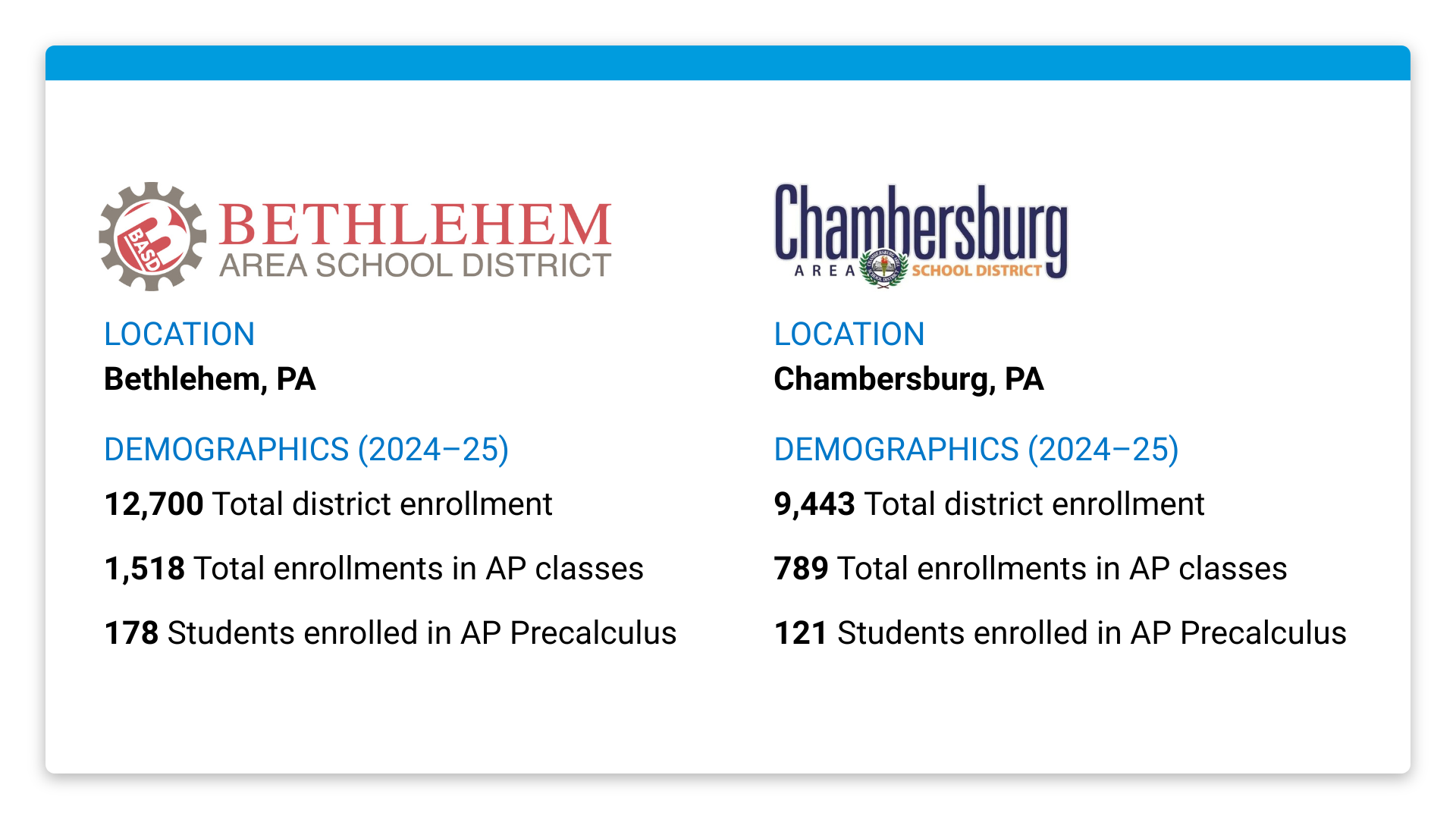
At Freedom and Liberty High Schools in BASD, we enrolled 85 students in AP Precalculus in the 2023-24 school year. We grew that number by 109% in the 2024-25 school year to 178 students enrolled in the course. In both school years, more than 80% of our AP Precalculus exam takers scored 3+, making them eligible for college credit. Districtwide, our total number of students taking AP courses grew by 15% over the two school years. These gains suggest that adding AP Precalculus can bring new students into AP while encouraging continuing AP students to deepen their engagement.
“Based on how I used to teach the honors course, it was an easy transition with only a few new concepts and vocabulary additions needed to execute the higher-level instruction that was predominantly taking place prior to the updated course of studies at our district.”
Christopher Bilotti, Mathematics Teacher, Freedom High School, Bethlehem Area School District
At Chambersburg Area Senior High School, we experienced notable growth year-over-year following the conversion of all precalculus sections to AP Precalculus. In the 2023-24 school year, 79 students took AP Precalculus, with that number growing 53% to 121 students in the 2024-25 school year. And, among AP Precalculus students who were in their first year taking AP, 63% went on to take AP Calculus AB or BC, significantly exceeding the national average of 48%.
Just as powerful as the data are the voices of our students who describe AP Precalculus as impactful and confidence-building:
Hannah F.: “I have a feeling the college major I intend to study will be challenging. I need to keep in mind my experience with the class so that I can get through the challenges.”
Hayden L.: “I no longer am afraid to raise my hand or ask ‘why.’ In college, I will 100% have classes where I struggle and, because of AP Precalc, I will not be afraid to go ask the teacher for a little help because there is nothing wrong with that.”
Mady K.: “Ultimately it taught me that if something doesn’t come easy to me later in life or in my career, that putting the extra work in makes a difference.”
The experience with AP Precalculus in both Chambersburg and Bethlehem demonstrates that access can create opportunity and cultivate students who are ready, confident, and excited for what comes next.
“Many students initially struggled with the difficulty of the material, but they learned how to manage the workload and develop stronger problem-solving skills. ... Past students often recognize that this struggle was valuable preparation for college, giving them a clearer understanding of the perseverance and discipline required for success in higher education.”
Christa Newton, Mathematics Teacher, Chambersburg Area Senior High School
Practical Pointers
Unify Leadership Early: Securing support from all levels of leadership will help drive success. Bring board members, district leaders, and principals into the “why” early, so expectations, master schedules, and staffing align with the core tenet of expanded access—and how AP Precalculus fits in.
Energize Faculty: Protect collaboration time and provide AP-specific professional learning opportunities so teachers start confident on day one.
Partner with Families: Explain the benefits of both the AP course and the AP Exam, and point families to free support available to students. When parents and guardians understand the value of the course, they become active partners in encouraging student success.