Rural and Ready: AP Seminar for Every Sophomore
Success in education rarely comes from a single initiative—it’s the result of intentional decisions considering systems, instruction, and access. In Kentucky’s Shelby County Public Schools, we examined our practices and restructured our approach to ensure every student has access to advanced learning opportunities. At the center of this effort is English 10: AP Seminar, a course that has become a key entry point to advanced learning and opportunity.
Identifying the Opportunity
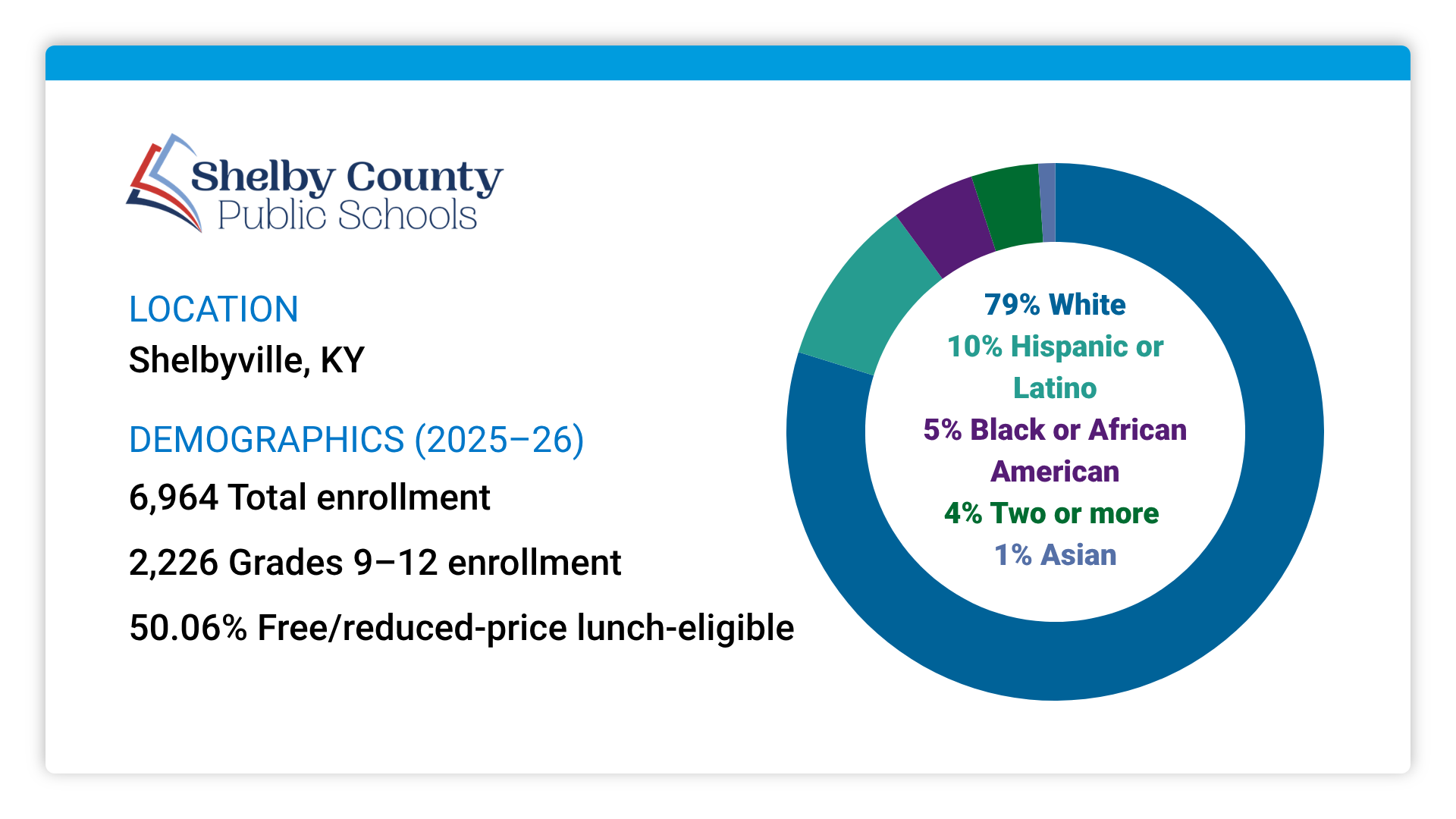
In our rural fringe district outside of Louisville, Ky., recognized for its equestrian and spirits industries, approximately two-thirds of our students go on to college. However, like many communities, persistence has been a challenge, with only about 25% earning a four-year degree after five years.
When we analyzed the makeup of our Advanced Placement® classes compared to our overall student population we found troubling realities. The students who were most economically disadvantaged did not have access to the most rigorous coursework that builds college readiness.
Simply put, our community expects and deserves better.
As we examined our own practices and structures, we recognized that student outcomes reflected artificial barriers created by legacy systems and assumptions that unintentionally limited access. Success for us would hinge on four key levers: master scheduling; teacher professional development; funding; and, most critically, creating a clear, accessible entry point into advanced coursework for all students.
Turning Opportunity into Action
We first looked at our master schedule. Our two district high schools differed in their course offerings—a certain AP course may be offered at one high school, but not the other. So, we aligned the scope and sequencing of our English, math, science, and social studies courses.
We also eliminated honors classes and converted them to AP. This simplified decision-making for students and signaled a clear expectation—advanced coursework is for everyone. To reduce barriers to AP Exam participation, our Board committed to funding all AP Exams, creating a risk-free opportunity for students to potentially attain college credit.
At the center of this redesigned system is English 10: AP Seminar. We selected AP Seminar because it develops essential skills students need across disciplines—research, argumentation, collaboration, and communication—making it an ideal entry point for those new to advanced coursework. Through performance tasks that require students to analyze complex texts, evaluate multiple perspectives, and present evidence-based arguments, students are building the confidence and skills needed for success in future AP courses and beyond.
“We adopted AP Seminar the second it was offered. We saw, and continue to see, AP Seminar as a strong introductory course for first-time AP students. It truly is a gateway course for students to the world of higher-order thinking. We have seen tremendous growth in achievement as a result of focusing on this course.”
Adam Hicks, assistant superintendent of curriculum, instruction, and assessment, Shelby County Public Schools
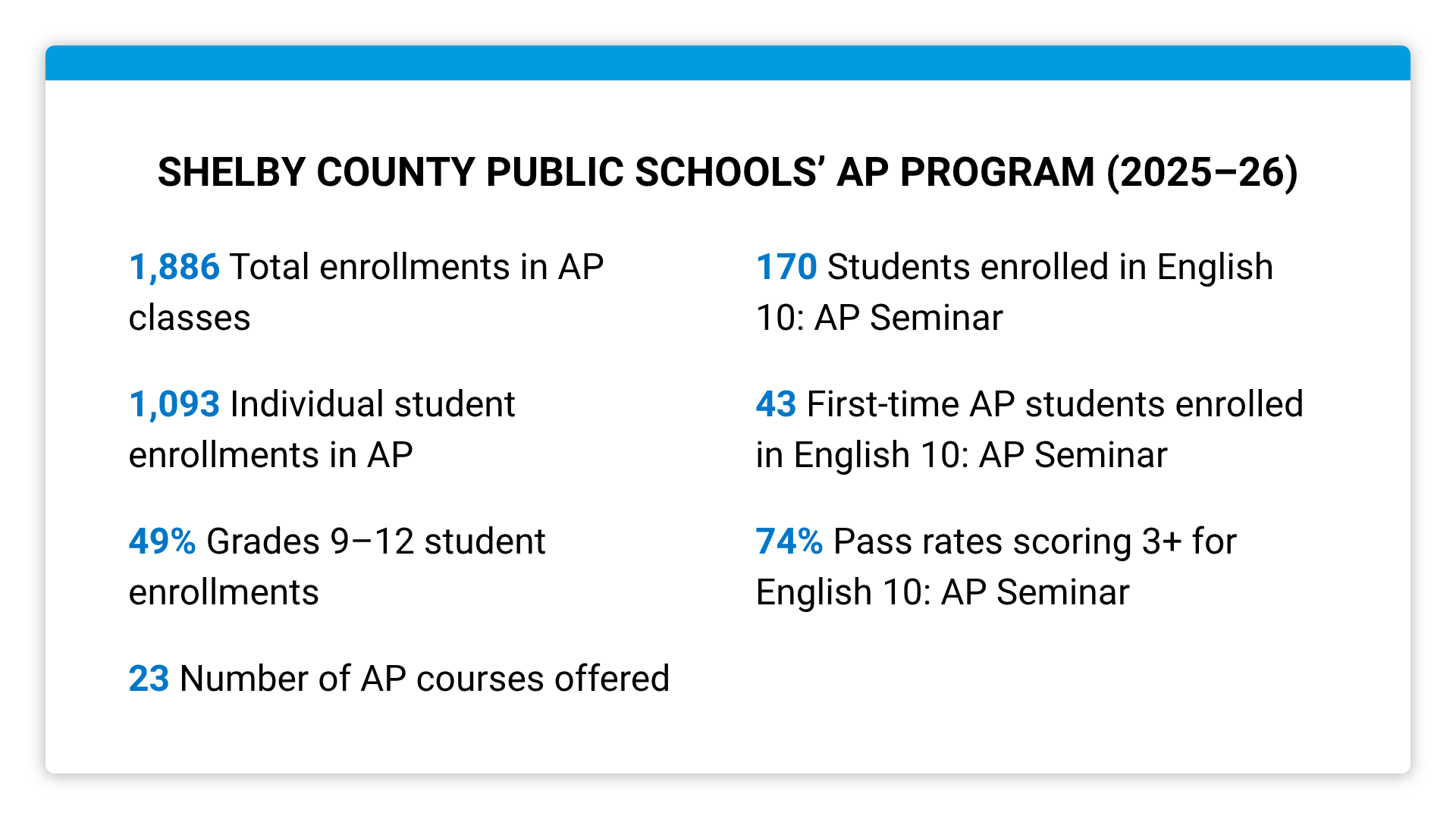
All sophomores now have the option to take either English II or AP Seminar, creating a clear and accessible on-ramp into AP. Enrollment in English 10: AP Seminar has grown by 36% year over year, reflecting rising student interest and expanded access. Currently, 25% of AP Seminar students are taking AP for the first time, demonstrating how the course is expanding participation and serving as a gateway to broader engagement. As more students enter AP through this pathway, the district is seeing gains in performance across the curriculum and increased enrollment in AP courses overall.
To make this sustainable and successful across classrooms, we invested in our teachers. Our AP educators now participate in a professional learning community, meet quarterly for instructional practice collaboration, and attend an in-person AP Summer Institute—building both confidence and instructional expertise to support all learners.
Evaluating the Outcomes
The results of our efforts are now coming into view, and it’s all open to the public, thanks to the community dashboard we created. This is where we report our success and ongoing progress, which is helping change the narrative around AP. For example, last year, we had 466 qualifying scores on all our AP Exams, a 92.6% increase in qualifying scores over the previous four years.
We’re also seeing meaningful academic gains. English 10: AP Seminar strengthens a student’s ability to analyze complex texts and use evidence to support their thinking—skills that are reflected in state English and Language Arts (ELA) assessments. In Kentucky, 10th graders are assessed in reading and 11th graders are assessed in writing. At Martha Layne Collins High School, for example, reading scores ranking as “proficient” or “distinguished” jumped 8 percentage points from 32% to 40% in a single year. Truly, our work is moving the needle.
These results are consistent with a recent study evaluating AP Seminar as English 10 and its impact on state ELA assessment performance. The study concluded that English 10: AP Seminar students are significantly outperforming their peers: reading scores for 87% of AP Seminar students met or exceeded benchmarks compared to 73% of advanced/honors English 10 and 36% of grade-level English 10 students. Similarly, writing scores for 78% of AP Seminar students met or exceeded benchmarks compared to 65% of advanced/honors English and 35% of grade-level English 10 students. These findings reinforce our move to collapse Honors English 10 into AP Seminar, ensuring more students benefit from stronger outcome potential.
Beyond individual achievement, English 10: AP Seminar is also strengthening the broader system. Schools with higher participation AP Seminar in sophomore year tend to see higher enrollment in AP courses in grades 11 and 12, supporting its role as a gateway to advanced learning.
“I saw many students leave our school having mastered the content with 3s, 4s, and 5s, which allowed them to accelerate their college experience. That said, the most important result of that work is how much it helped them grow as scholars. Even without the opportunity for college credit, that is the largest—and perhaps most important—part of the College Board experience.”
Daniel Pfaff, director of curriculum, instruction, and assessment, Shelby County Public Schools
Looking Ahead
Kentucky recently transitioned its statewide college entrance exam to the SAT, so we are building upon this momentum. Our long-term vision is to align the full continuum—PSAT assessments, AP Potential™, AP coursework, and the SAT—to guide students toward postsecondary success.
In a rural district like ours, expanding access to opportunity is essential. By removing barriers, investing in our educators, and using English 10: AP Seminar as a foundational experience, we are ensuring that every student has the chance to engage in rigorous learning and prepare for what comes next.
We believe our story demonstrates what’s possible when systems are aligned, expectations are raised, and opportunity is made accessible to all.
“Students rise to the challenge of engaging with academic texts that are far above what we think of as ‘grade-level appropriate’ for sophomores. I am always astounded at how much their research skills develop as they learn to grapple with academic journals and texts that go beyond what we think of for ‘high school English’ courses.”
Kathryn Brown, English teacher, Martha Layne Collins High School
Practical Pointers
Build a Clear On-Ramp into AP: Position AP Seminar within the core course sequence (e.g., English 10) so all students have an entry point into advanced coursework.
Use Data to Expand Access: Leverage objective indicators (e.g., students performing at or above benchmark levels on standardized tests) to proactively enroll students in AP, while keeping enrollment open to any student who chooses to participate.
Partner with Teachers: Incorporate teacher input into course selection and master scheduling, leveraging their insight to identify and encourage students who may not self-select into AP but are ready to succeed.
Align Systems for Access: Standardize course offerings across schools and remove competing tracks to ensure all students have consistent access to AP opportunities.
Remove Financial Barriers: Fund AP Exams and reinforce that participation is a no-risk opportunity to build skills, readiness, and college credit.