Early AP Access as the Norm, Not an Exception
Grade point averages and teacher recommendations are typical ways schools identify students ready for Advanced Placement® coursework. At J.P. McCaskey High School, we added a third channel—listening. We heard from our incoming students that they were ready for more challenging coursework and we realized we could expand our advanced learning—not only to juniors and seniors, but to 9th and 10th graders as well—by simply acting on their signals.
Identifying the Opportunity
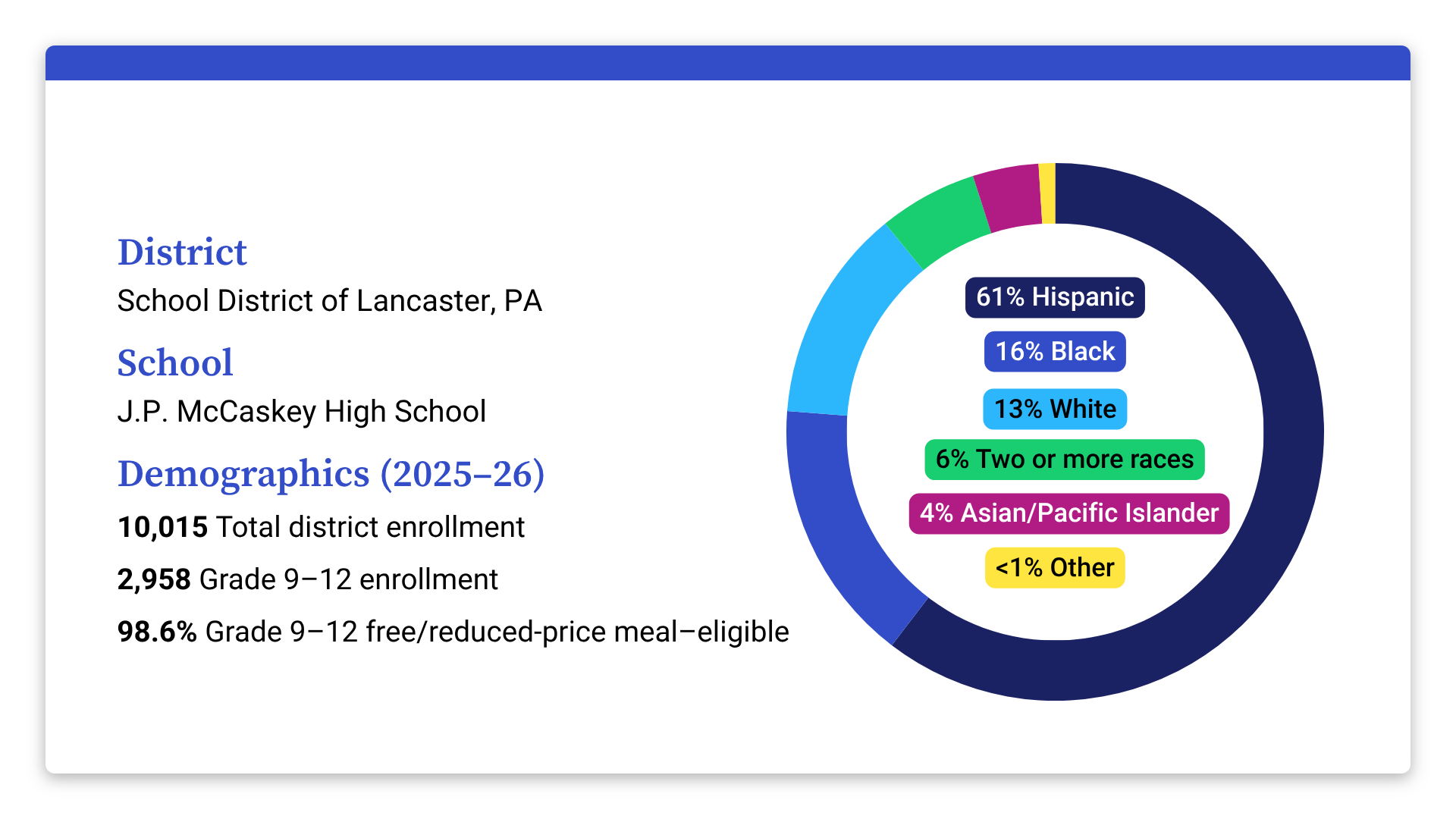
Our school, located in Lancaster County, a scenic region in south-central Pennsylvania known for its rich agricultural roots, educates approximately 2,800 students among an entire district of approximately 10,000 students. Like many school systems, our population is declining—and we find ourselves competing for students who have choices like charter, cyber, and private schools. As our principal, Justin Reese, explains, “I’m recruiting, in some ways, like a small college.”
State and local budgetary demands add further nuance. Our district is one of the state’s most economically challenged. More than 90% of our students are eligible for free or reduced-price meals.
What some may see as obstacles, we see as a call to action toward building a culture where academic challenge is expected, supported, and accessible. So, we are focusing on offering opportunities that no one else does. In fact, we want our high school to be a “destination,” and that includes early engagement in AP.
Turning Opportunity into Action
While AP enrollment is often associated with learning at the junior and senior level, we made the bold move beginning in the 2022–23 school year to offer AP classes to freshmen and sophomores. A former superintendent inspired this shift, aiming to remove barriers and expand advanced learning access—and today, nearly 40% of our AP student body is in 9th or 10th grade.
As a single traditional high school district, this commitment may seem both risky and unmanageable. We started small, offering two AP classes where freshman and sophomore performance data indicated a stronger likelihood of success. Courses that aligned with our grade-level curriculum—AP Human Geography and AP English Literature and Composition—appeared to be the most plausible choices.
Growing AP this quickly might suggest something had to give elsewhere. It didn't. Our district covers the cost of dual enrollment courses for students, and that commitment held steady even as our AP numbers grew. We didn't think of it as choosing one pathway over another—just building out more of them.
We didn’t intend this move to be a “one-and-done” exercise. We envisioned an evolving approach over the long term to strengthen readiness for college, career, and military service. So, we created our own internal pipeline to nurture AP growth among rising sophomore, junior, and senior students.
First, we enlisted our strongest AP teachers to lead the AP courses enrolling 9th and 10th graders. When a teacher who works with our juniors and seniors also taught a freshman-level section, students built a relationship with that teacher early—and that relationship became a bridge to harder coursework later. We weren't only building a pipeline of courses. We were building a pipeline of trust, one that made it more likely a student would come back for something more challenging later.
We also created a champion system for first-time AP students, pairing each one with the best partner for their success—a fellow athlete, a trusted teacher, or another trusted individual—to support their success. As a result, students have embraced a mindset where risk-taking and bravery are encouraged. We also use statewide assessment data and projections to reach out to students who may not have thought of themselves as AP students—and that same mindset helps them say yes.
Our annual weeklong “Pic Your Path” event, a play on the word “picture,” is another way we boost future AP enrollment interest. The event invites 8th graders and McCaskey students to visit a class station of interest, including AP, for a hands-on demonstration of an activity associated with the course’s learning. We keep it fun with a photo booth and other visual props students can use to literally picture themselves in a class and future career.
This effort to increase academic rigor represented a huge cultural shift, and it meant treating every student as an individual. We established frequent check-ins with students and parents, as needed, and we built in tutoring opportunities: before school, after school, during school, and even on weekends.
We also realized our students needed more instructional time overall. So, we revised our bell schedule from an 8-period day with 49-minute lunches to a 10-period day with 30-minute lunches.
We did not limit individual attention to the students. We invested in teacher training, created collaboration opportunities for AP teachers, increased teacher planning time, and encouraged our teachers to be AP readers to deepen their subject matter knowledge.
“My advice is to begin with a clear purpose. Expanding AP offerings should not be about increasing the number of courses on a master schedule. It should be about creating meaningful opportunities for students to engage in rigorous learning and preparing them for success after high school.”
Justin Reese, Ed.D., principal, J.P. McCaskey High School
Evaluating the Outcomes
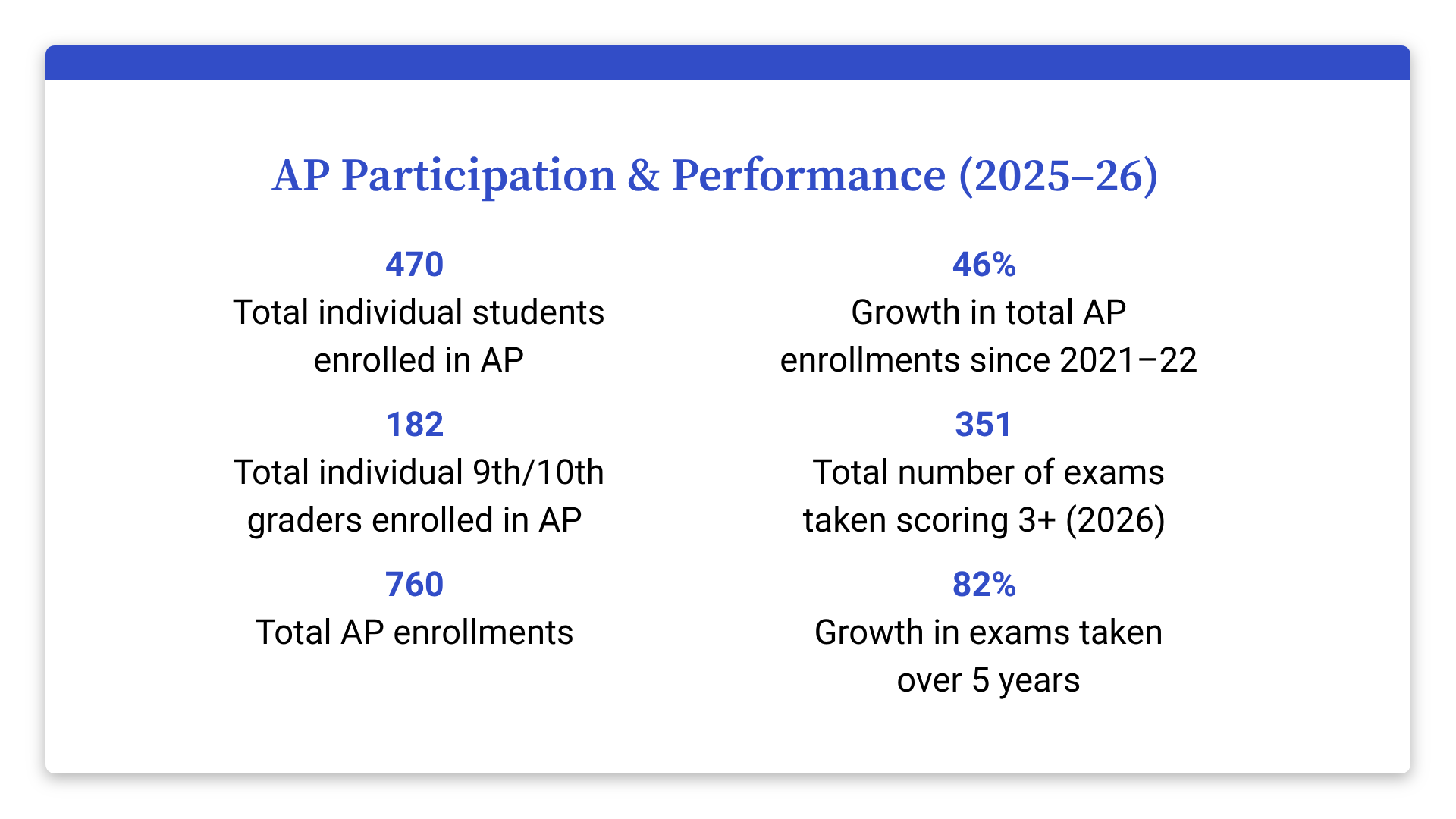
The simple act of listening to our students several years ago is paying off. By leading with early access over selectivity, our AP enrollments are up 46% in the past five years. Equally remarkable is the upward trajectory of AP Exam scores. In 2021, our students took 322 AP Exams and scored 3 or higher on 117 of them (36%). In 2026, they took 587 exams and scored 3 or higher on 351 (60%). Over a 5-year period, scores of 3 or higher grew 200% while exams taken rose 82%. We credit this growth not solely to opening the door to AP earlier, but to what we built around it to support both students and teachers.
Every year, we see students enrolling in an AP course who may not have initially seen themselves there. With the right instruction, encouragement, and support, they not only succeed but often discover a level of confidence that extends well beyond the classroom.
“I enjoy teaching Advanced Placement courses because of the quality of discussion and engagement in class. I believe taking just one AP class gives students a better chance at going off to college and succeeding.”
Todd Mealy, social studies teacher, J.P. McCaskey High School
For districts reluctant to expand access, especially to younger grade levels, we suggest starting small—adopt just one or two courses, so you don’t overwhelm your system.
Also, take steps to build healthy relationships between central office and school leadership. We are fortunate to have a great partnership between our district and the high school that recognizes AP is ultimately about expanding possibilities. It gives students access to experiences that prepare them for success after high school while reinforcing the belief that every student deserves the opportunity to be challenged, supported, and inspired to achieve at the highest levels.
Practical Pointers
Add Channels: Grade point averages and teacher recommendations identify some students who are ready. Adding channels—student interest, assessment data, direct outreach—identifies the rest.
Stack Funding Sources: For students needing support to cover exam fees, start with AP Exam fee reduction and available state and federal funds. Then, build a community-supported pool to close any gaps. Local partners are often glad to be asked.
Start Small and Scale Deliberately: One or two courses done exceptionally well build the credibility and capacity to add more.
“We’re proud of the college persistence* of our AP students. Students who did not take an AP course currently persist at a rate of 52.4%, but persistence among AP students jumps to 84%. This further validates research showing AP students are more likely than their peers to attend college and graduate on time.”
Karen Wynn, director of curriculum, instruction, and assessment, School District of Lancaster
* The School District of Lancaster defines persistence as any college enrollment between June 1 the year after high school graduation and December 31 the year after high school graduation after being enrolled in the first year of college at any time.