The Transfer Effect: How AP Seminar Skills Show Up Everywhere
When one of our graduates stood in front of our entire faculty and named one class that stuck with him most, he pointed to AP Seminar—the class where he first presented, researched complex issues, wrote about his findings, and defended his conclusions. Today, he runs his own finance company and says he still uses those skills every day. His experience has its roots in a decision we made over a decade ago: offering AP Seminar to our sophomores. It’s a decision that's still paying off in ways that reach far beyond that one class.
Identifying the Opportunity
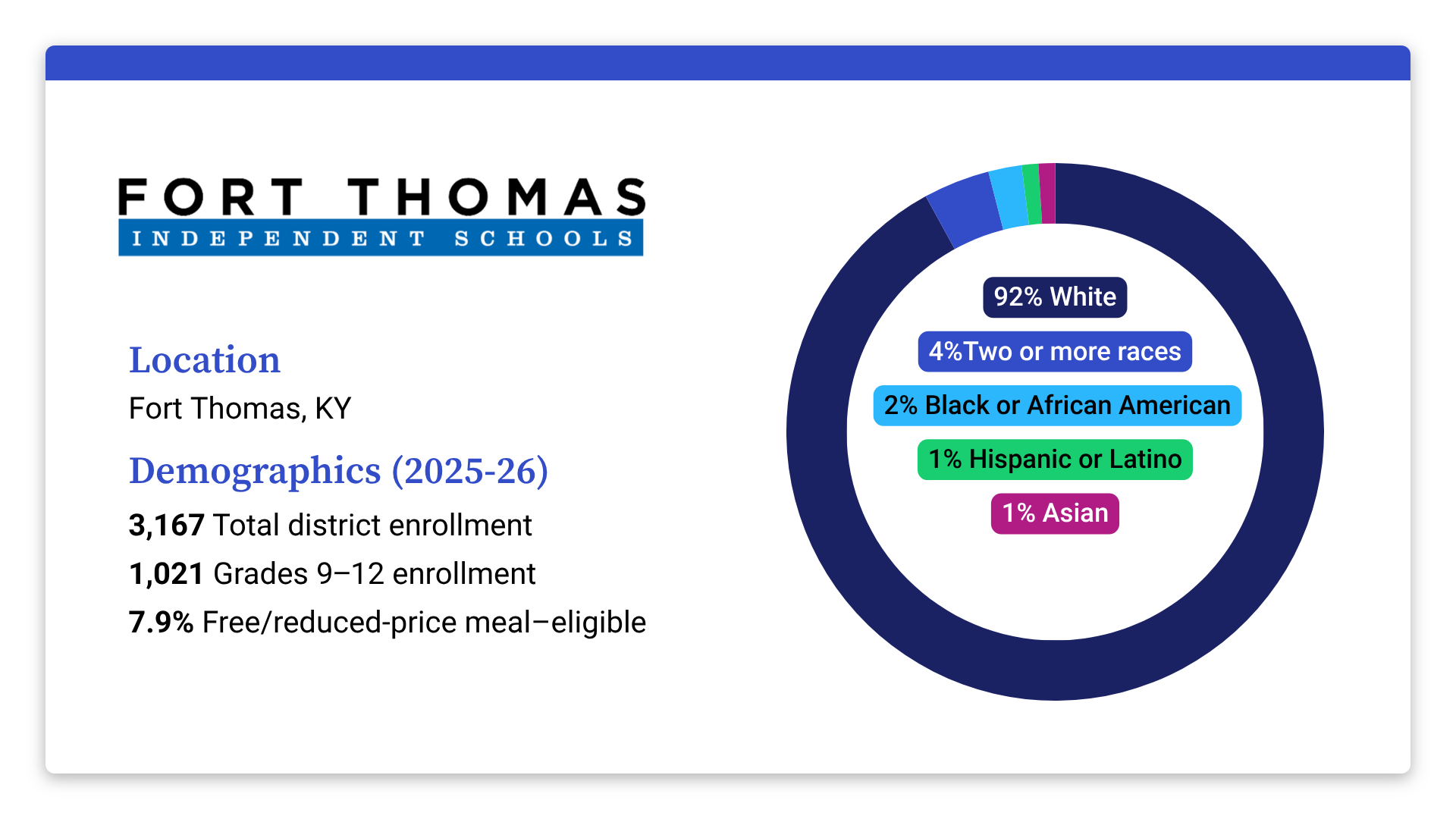
Fort Thomas Independent Schools is a single-high-school district in Kentucky, just outside Cincinnati. There are about 1,000 students in grades 9‒12, and just over 3,100 students districtwide. AP Seminar had long been a common offering for juniors, but we noticed a gap in our students’ research skills and believed those skills needed room to develop earlier. Moving AP Seminar to English 10 gave us a way to close that gap while building these skills sooner in a student’s high school career. AP Seminar can sit in different places in a school's schedule. For us, English 10 was the right fit.
Importantly, we wanted students to build skills that transfer beyond one classroom: presentation, research development, collaboration, data analysis, and the ability to view topics from multiple perspectives—skills valuable across disciplines and well beyond high school.
Turning Opportunity Into Action
We knew our students needed a foundation in skills essential for success in 11th and 12th grade: presenting claims, marshaling evidence, and delivering solutions.
So, in 2014, well before other districts were adopting AP Seminar earlier in the high school sequence, we decided to offer AP Seminar to our sophomores. We wanted to set our students up for success, so we converted Honors English 9 to Pre-AP English 1.
To create relevance for students, we structured AP Seminar thematically, and we changed themes yearly to address local, state, or national issues that would engage them. For example, our first year we looked at local poverty and homelessness. Another year, we explored the drugging of racehorses, of interest to our students living in a state focused on the horse-racing industry.
The approach had impact, even helping create a positive school climate while normalizing civil dialogue. Notably, the thematic approach created buzz among all students. Grade-level English students wanted to do what AP Seminar students were doing. So, we began adapting our standard English 10 course to infuse some of AP Seminar’s framework.
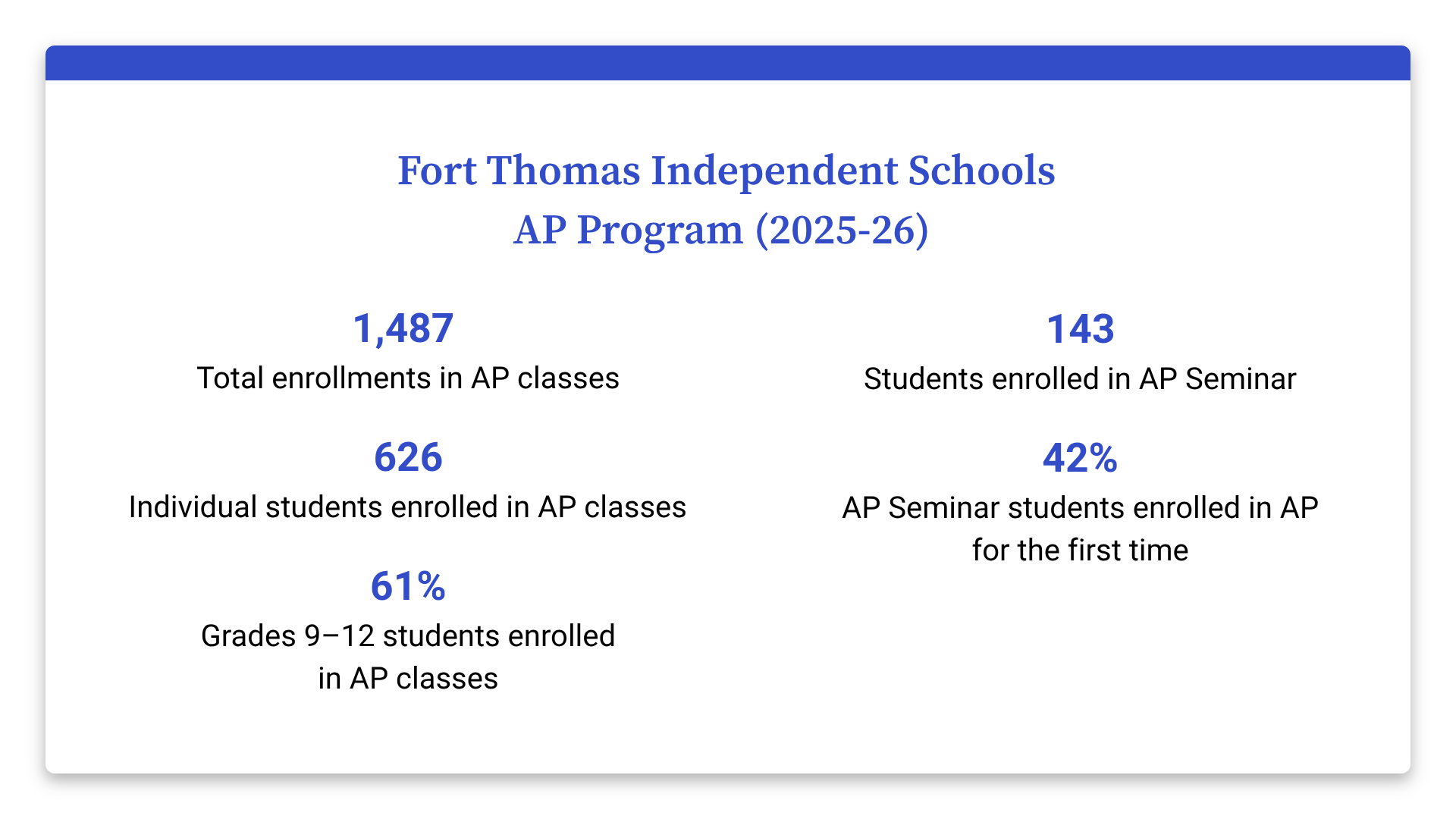
Now, 60% of our sophomores enroll in AP Seminar, and 42% of these AP Seminar students are taking AP for the first time.
"By moving beyond pre-packaged answers, students develop intellectual stamina to navigate messy problems that don't have clear solutions, giving them a massive head start on tackling deeply complex issues of college and adulthood. They exit the course with a sophisticated ability to analyze information that serves as a lifelong filter for bias and misinformation.”
Katie Stewart, teacher, Highlands High School
Evaluating the Outcomes
Our students have gone from passive consumers of information to active, critical thinkers and investigators. Students have developed essential tools for informational literacy in the modern world by learning to evaluate complex issues through various perspectives. This shift has fostered intellectual autonomy. The focus has moved from finding “the right answer” to constructing the most well-supported argument using vetted, relevant, and credible evidence.
Katie Stewart, one of four AP Seminar teachers, observed, “They’ve stopped waiting for me to give them the answer. They start finding it themselves.”
Additionally, AP Seminar has become a gateway course to additional AP coursework. Since 2022, we’ve seen a 33% increase in students enrolled in AP, and the number of AP Exams taken has risen more than 50%. In 2026, we administered 1,449 AP Exams, resulting in 4,730 college credit hours equating to $2.2 million in potential tuition savings.
Participation is one measure of success. Assessment performance is another. A College Board study released in March 2026, AP Seminar as English 10: Evidence on State ELA Assessment Performance, examined the relationship between enrollment in AP Seminar as an English 10 course and student performance on state English Language Arts assessments across Kentucky, New York, and Texas. In Kentucky, the study found that 87% of AP Seminar students met or exceeded the state reading benchmark, compared with 73% of students in Advanced/Honors English 10 and 36% of students in On-Level English 10. A similar pattern was found for writing: 78% of AP Seminar students met or exceeded the benchmark, compared with 65% and 35%, respectively, in the Advanced/Honors and On-Level English 10 classes.
Our own results point in the same direction. In Kentucky, 10th graders are assessed for reading, and 11th graders are assessed for writing. Since 2022, our 10th grade reading scores have risen from 71% to 76%, scoring Proficient or Distinguished, far exceeding the state proficiency rate of 48%. Similarly, 70% of our 11th graders scored Proficient or Distinguished in writing scores in 2024-25, exceeding the state’s 45% proficiency rate. While these schoolwide scores reflect all 10th and 11th graders, not just our AP Seminar students, we feel strongly that AP Seminar is helping drive our students’ success.
Beyond the numbers, observations of teachers in other courses have provided evidence of the transferability of AP Seminar skills. Biology and history teachers, for example, can tell when they have an AP Seminar student or graduate by the way they ask questions or undertake a task.
There's a fitting irony here: The same claim-evidence-reasoning model we teach in AP Seminar is exactly how we'd defend the decision to offer it. The claim: AP Seminar belongs earlier in high school. For our students, that means 10th grade. The evidence: Rising AP Seminar enrollment, first-time AP participation, and teachers across disciplines who can spot a Seminar student by the way they think. The reasoning: When students stop asking "When am I ever going to use this?" and start standing up to defend an evidence-based position with the confidence of a working professional, the claim holds.
“I have been teaching AP courses for 19 years, including Pre-AP for a few years, and I believe the content and skills help prepare students beyond just ‘taking a test.’ They learn resilience, and they learn to embrace productive struggle.”
Angie Gintonio, teacher, Highlands High School
Practical Pointers
Inform Your Counselors: Make sure your guidance team understands the performance tasks required for AP Seminar so they’re prepared to address any concerns students raise with that team.
Set Students Up for Success: Make sure foundational skills are in place the year before students take AP Seminar. For us, that was grade 9. And think holistically across disciplines. AP Human Geography in 9th grade proved to be a great AP entry course for our students.
Be Flexible: Be open to adjusting curriculum in grade-level classes that could benefit from modifications inspired by an AP course’s framework, especially when students ask for it.